
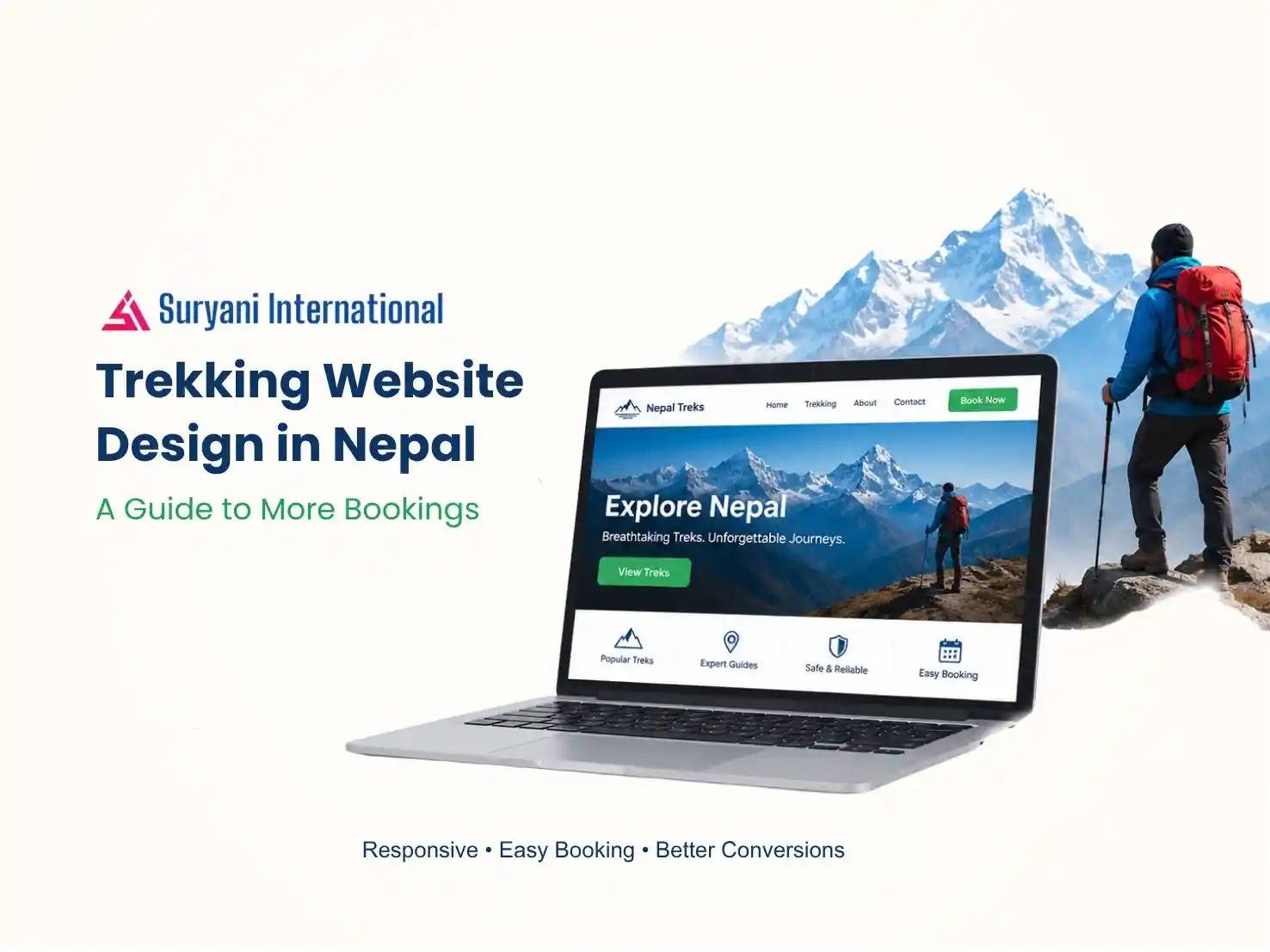
Trekking Website Design in Nepal means designing websites for trekking agencies in order to present their packages, attract customers, and make bookings on those sites.
What is the purpose of a trekking website? To turn a curious tourist into a client. If you have an attractive website that does not provide information about cost, difficulty level, and inclusion in one way or another, you will lose most of your visitors and clients to your competitors.
We at Suryani International have experienced this ourselves when creating trekking websites for different agencies operating in Nepal. In this article, we will give you an idea of what a good trekking website looks like in 2026 by giving you insights into tourists’ current behavior.
Why Trekking Companies in Nepal Need a Strong Website
Nowadays, most of the trekkers are doing a lot of research about the agency on their websites way ahead of coming to Kathmandu. They are comparing itineraries, reviews, and the pictures of past tours. If your website is unable to answer their queries, then you should be prepared for the worst, which is visiting your competitor’s website.
Your website will perform tasks that your employees cannot do at 2 in the morning. This includes answering questions about permits and giving information about the trail maps.
It Builds Trust Before the First Conversation
Trekkers are trusting you with their safety, money, and vacation time. Before they message you, your website needs to show:
- Real photos from actual treks, not generic stock images
- Guide and staff profiles with real names and experience
- Honest reviews, including ones that mention minor issues
- Clear licensing, permits, and safety information
- A phone number, email, and physical address that are easy to find
It Shows Off Your Trekking Packages Clearly
Every major trek you offer, Everest Base Camp, Annapurna Circuit, Manaslu, Langtang, Mardi Himal, Poon Hill, and Upper Mustang, deserves its own dedicated page. Each page should cover duration, difficulty, maximum altitude, cost, and what’s included.
Cramming ten treks onto one page forces visitors to hunt for information. Separate pages also perform much better in search results, since each one can target the exact trek a person is searching for.
It Turns Visitors Into Inquiries
A trekking website isn’t a brochure. It should actively invite visitors to take the next step through:
- A “Get a Quote” button on every package page
- A short inquiry form (name, email, trek, dates)
- A WhatsApp or Messenger link for quick questions
- A visible phone number for travelers who prefer to call
What Makes a Trekking Website Design Actually Good?
Trekking websites succeed if they make an absolute stranger trust your business to plan his/her journey. And there are only five factors: a clear homepage, easy navigation, genuine package pages, mobile-friendly design, and fast load speed.
Homepage that Makes Instantly Clear Who You Are and What You Offer
The visitors have already decided within seconds whether they will scroll further or not. Hence, you need an eye-catching photo or video at the top of your homepage, a concise one-liner that describes what kind of services you offer, and two buttons – one for treks and another one for contacts.
Don’t say “Your Adventure Starts Here” in a slogan; tell exactly what you offer: “We organize small group treks to Everest Base Camp, Annapurna and Langtang, guided by licensed local guide.”
Navigation that Does Not Require Any Efforts
Do not include more than five items in your menu: Home, Treks, About Us, Blog, and Contact. And if you organize a lot of different treks, group them geographically (Everest, Annapurna, Langtang, Manaslu) or in terms of their level of complexity (easy, moderate, strenuous).
Package Cards That Let People Compare Treks Fast
When the user checks out your treks page, they are looking for their choice. Make sure to include name, duration, difficulty level, max altitude, starting price, and “View Details” button so that visitors could choose from five treks during the time required to read one paragraph.
Mobile Friendly Design, As Most of Your Visitors Use Their Mobiles
Most of the travelers checking out trekking tours to Nepal use their mobiles, usually on the go or before sleeping. You may lose the booking process if your buttons are too small to tap, if the text is too small to read, or if your inquiry form doesn’t work properly on mobile devices.
Test your website not only on a desktop but also on a mobile phone. Make sure that filling out forms could be done easily with one thumb and that images are not causing performance issues.
Fast Loading Speed
Trekking sites often feature lots of images which makes them slow. You have to compress all images, use modern formats such as WebP, and not to load five videos on one page.
Trekking Website Design Styles, With Examples of When Each Works
None of the styles can be considered correct. They all depend on the company brand and its target audience.
Adventure oriented website design is good for trekking agencies working with treks and expeditions at high altitudes. Here you’ll have a lot of pictures of mountains, bright headlines and action-oriented “Book your Everest Trek“. Such design is suitable for agencies that want to attract travelers interested in adventure.
Minimal website design removes all decorations and emphasizes the informative value of a website. Such designs feature a lot of whitespace, clean fonts and layout. It will suit those agencies that want their visitors to compare packages fast without any distractions.
Luxury website design is good for trekking agencies offering private guides, premium lodges and customized itineraries. Such design features spacious layout, elegant fonts and more controlled browsing experience.
Website design focused on photography is good if you can offer unique photos of trails, guides and former customers of your agency. However, the design will look bad if the photos aren’t compressed because it will increase load time.
Booking oriented website design is for agencies providing standardized, fixed departure treks.
What Every Trekking Website Needs (Checklist)
Regardless of style, these features should exist on every professional trekking website:
- Mobile-responsive design
- Individual pages for each major trek
- Day-by-day itineraries
- Trek route maps
- Inquiry and quote request forms
- Real customer reviews
- A photo gallery from actual treks
- An FAQ section for each trek
- A blog with practical trekking guides
- Complete, easy-to-find contact information
- WhatsApp or messaging integration
- Clear pricing with inclusions and exclusions listed separately
How Do You Design a Trekking Package Page That Converts?
A trekking package page is where most booking decisions actually happen. It needs to answer every practical question a traveler has, in order, without making them scroll endlessly to find pricing.
Start With the Trek Overview
Put the essentials in a scannable box near the top: duration, difficulty level, maximum altitude, starting and ending points, best season, and accommodation type. Travelers should get this information in under ten seconds.
Create an Itinerary for Each Day
Create labeled days on your itinerary which describe your route, elevation changes, and where you will spend the night. Long paragraphs are difficult to read through on a mobile phone, so keep things concise by breaking it down per day.
Be Transparent with Pricing
Give an exact description of what is covered in the cost (permits, guides, porters, meals, accommodation, transportation), and what is not (international flights, insurance, tips, personal expenses). Ambiguous pricing is a sure way to lose trust quickly.
Include a Basic Trek Map
A route map is easy to include and allows trekkers to see their planned route. Maps don’t have to be elaborate, just accurate.
Embed Booking Buttons Across the Page
Rather than burying the “book now” button at the bottom of the page, include one at the beginning with a brief overview, once again in the middle after the itinerary, and once again at the bottom of the page.
How Much Does Trekking Website Design Cost in Nepal?
Pricing depends heavily on scope, but here’s a realistic way to think about it based on typical project ranges.
A basic website with essential pages, a handful of trek listings, and a contact form suits a new or small agency that mainly needs an online presence and simple lead capture.
A professional website adds custom design, SEO-ready page structure, dedicated pages for every trek, a blog, and stronger branding. This is the right tier for most established agencies competing for search traffic.
An advanced website includes online booking, payment gateway integration, multilingual content, and possibly a CRM connection. This suits larger operators handling high volumes of fixed-departure bookings.
Instead of comparing agencies purely by their quote, ask what each option includes long-term: hosting, maintenance, SEO support, and how easily you can update trek prices and availability yourself.
Should You Use a Free Trekking Website Template?
Yes, if you’re testing an idea or have a very limited budget. No, if you’re running an established agency that depends on the website for real bookings.
What Free Templates Are Good For
Free templates give you a working website fast and at low cost. They’re a reasonable way to get online while you figure out your branding and validate demand for your services.
Where Free Templates Fall Short
Most free templates are generic, meaning your site can end up looking like dozens of others using the same theme. Customization is often limited, technical support is minimal, and some free templates carry security or performance issues that hurt your search rankings.
It’s also worth knowing that “free template” doesn’t mean “free website.” You’ll still pay for a domain, hosting, and likely some paid plugins or customization work to make it functional for a real business.
| Factor | Free Template | Custom Professional Site |
|---|---|---|
| Upfront cost | Low | Higher |
| Customization | Limited | Extensive |
| Branding | Generic | Unique to your company |
| SEO potential | Varies, often weak | Built in from the start |
| Booking features | Basic or none | Fully customizable |
| Ongoing support | Usually none | Available |
WordPress or Custom Development: Which Should You Choose?
WordPress is the logical choice for most trekking agency businesses. Setting up is much quicker and easier, there are good SEO add-ons, and it allows non-tech people to edit their blogs and treks without needing a programmer.
Custom programming would be ideal for those trekking companies that require some complex logic behind booking, as well as high-level integration with CRM or any other payment system that off-the-shelf themes cannot provide.
Here at Suryani International, we offer both WordPress website development and fully custom website development. If you require any sort of SEO-friendly trekking website, be it basic or advanced with custom booking system and other functionalities like CRMs, payment gateways, and so forth, then we can design and develop a fully customized solution for your business.
Moreover, there have been many trekking companies who came to us in order to build up their websites, some of them are, for example, Discover Himalaya Nepal, Hairy Yak Adventures and many more.
In case you are confused between choosing one solution over the other, Suryani International will assist you in deciding the appropriate technology for you.
How Can a Trekking Website Improve Its SEO?
For SEO of a trekking website, there are three main points that should be considered, dedicated pages for each trek, useful guides and fast clean technical side of the site.
Create Dedicated Pages for Each Trek
It is impossible to make one page rank well for “Everest Base Camp Trek,” “Annapurna Circuit Trek,” and “Langtang Valley Trek.” Each trek requires a separate page with specific content.
Publish Useful Guides
The guides have to be related to the queries that tourists look for – the best time to go trekking in Nepal, the price of an Everest Base Camp trekking, list of things to pack, permits and comparative trek difficulties.
Give Descriptive Names and Alt Text to the Images
It is better to rename files before uploading. For example, the file with name “everest-base-camp-trek-nepal.jpg” describes the image for Google and artificial intelligence, not “IMG4521.jpg.”
Keep the Technical Basics in Order
HTTPS, a clean URL structure, an XML sitemap, and fast page load speed all matter. None of these are glamorous, but skipping them limits how well even great content can rank.
Common Mistakes That Hurt Trekking Websites
Too many photos, not enough information. Stunning mountain photography matters, but travelers still need cost, difficulty, and itinerary details to make a decision.
- Confusing navigation: If a visitor can’t find your Everest Base Camp page within two clicks, you’re losing bookings to a competitor with simpler navigation.
- No clear next step: Every page should tell the visitor exactly what to do next, whether that’s “Get a Quote” or “Book Now.”
- Ignoring mobile users: A form that’s hard to fill out on a phone will lose you inquiries, even if the desktop version looks great.
- Outdated trek information: Old prices, expired permit rules, or broken contact forms damage trust fast, especially for travelers making a significant financial decision.
- No reviews or trust signals: Real reviews, real guide profiles, and real photos matter more than a polished design template.
Frequently Asked Questions
What is trekking website design?
Trekking website design refers to the design, layout, and style created specifically for trekking or adventure travel companies. This includes trek package pages, itinerary, prices, trek guide information, reviews, and a way to inquire or make a booking from the visitor side.
What should the trekking company website contain?
It should minimally have the homepage, separate pages of treks, trek itinerary per day, prices, trek map, customer reviews, FAQ page, and an easy contact facility using forms, calling or messaging.
How much is trekking website design in Nepal?
The price depends on the number of pages needed, use of WordPress or not, and booking and payment features as well. An advanced website having online booking and multilingual feature is more expensive compared to a basic site without those features.
Can I create a trekking website for free?
You can get a free template to create your website, but then you will need to invest at least in the domain and hosting facilities. Moreover, you won’t be able to customize easily as well as will miss out on the SEO structure that a paid website will have.
Is WordPress suitable for a trekking website?
Yes, it will be perfect for most travel agencies. Responsive designs, SEO, blogging, and booking forms integration are available with WordPress. This way, your company will be able to update information about tours without having a programmer.
How can I increase bookings on my trekking website?
Make sure that you use transparent pricing, quick page loading, booking forms optimized for mobile devices, user reviews, and clear CTAs on every trek. A person who finds what he needs instantly is more likely to make an inquiry.
Is online booking needed on a trekking website?
It all depends on your type of business. Online booking is necessary for treks with fixed departure dates and prices. For custom tours, a quotation request form would work better.
Conclusion
Your trekking website is often a traveler’s first impression of your company, and first impressions decide bookings. A fast, honest, mobile-friendly site does more for your business than any amount of decoration.
Suryani International builds trekking websites that combine strong design with real SEO and booking results, backed by our reputation for the best website design in Nepal.
Ready to turn more visitors into bookings? Contact Suryani International today.